


Film Review by Tim Estiloz
If you want to dissect under a microscope the multiple, often incongruous and controversial facets of music icon Michael Jackson; then, various aspects of his personality, his life and his undeniable performing talent can all be true, valid and significant at the same time. As the child lead singer of “The Jackson 5” in the 70’s, he was the pint sized singing prodigy and dancing dynamo that led the group of brothers into worldwide superstardom on the pop charts. As a teenager into young adulthood; he became a worldwide superstar on his own terms charting a solo multi-Grammy winning career with dozens of hits and selling millions of albums when you actually had to go to the record store to buy them.
As an adult, his 1982 album “Thriller” broke historic records by selling, to date, 67-million copies worldwide, winning eight Grammy awards and it remains the #1 best selling record album of all time. Jackson’s amazing success as a record artist, music video pioneer and spectacular stage performer led to many dubbing him “The King of Pop”, a title he arguably deserves and no doubt relished himself.
On the other hand, Jackson also came to be known and derided by the media and portions of the public for what ultimately became increasingly unique, strange or even weird and outlandishly bizarre behavior, depending on who you talk to. Front page tabloid headlines and photos of Jackson sleeping in hyperbaric chambers, his pet chimpanzee “Bubbles”, buying the skeleton of the Elephant Man, astonishingly marrying the daughter of another music “King”, Elvis Presley
… and of course, the odd surgical evolution of his face from a once handsome young man into something well… bizarrely different. Jackson’s eccentricities and forever morphing physical appearance sold thousands upon thousands of copies of the tabloid rag, the National Enquirer and others at supermarket checkout aisles over the years.
Somehow, the superbly talented young kid from Gary, Indiana had become known as “Wacko Jacko”.
… and then, there were the rumors and allegations of child sexual abuse. Allegations that Jackson vehemently denied and was ultimately acquitted of in a court of law. Yet, despite that, as well as an out of court financial settlement with one of his accusers, the stigma of alleged pedophilia remains in the minds of some.
So, yes… Michael Jackson’s wide ranging strange and stellar life; parts private, personal and weirdly public is one of amazing highs and devastatingly embarrassing lows. It’s a life trajectory filled with multiple twists and turns tailor made for big screen exposition and exploitation; though Jackson’s story has been already told twice via TV movies and miniseries.
His is a life of many unique and singular chapters; each one very different from the next.
Which now brings us to director Antoine Fuqua’s long awaited biopic about the pop superstar entitled simply, “Michael”. Early reviews of the film criticize it as being incomplete, of lacking depth or, most critical of all, that it’s a “whitewash” of Jackson’s life. That latter arguable assessment of the film is only questionably valid if you sum up Jackson’s life and career solely by the legitimately troublesome rumors and allegations regarding children that dogged his latter career.
Indeed, Fuqua had planned to include and shot scenes that directly dealt with that controversial portion of Jackson’s life for his film. However, legal issues surrounding the settled case being depicted prevented the final inclusion of those scenes and required reshoots. The result is a film that focuses on that portion of Jackson’s life with the Jackson 5 to his ultimate professional and personal emancipation away from the group and from his controlling, abusive father to embark on a mind-bogglingly stellar and successful solo career upon the release of his successful “Bad” album.
I submit that the result makes for a superbly entertaining chronicle of a unique American success story; a talented young black adolescent comes from meager beginnings to become one of the world’s most famous, most wealthy and most successful entertainers of all time.
Treacly and saccharine?… Yes.
Sentimental and overly simplistic? … Absolutely.
But, when the news on TV is a daily “Debbie Downer” filled with craziness and legitimate hints of World War III; a dose of saccharine sentimentality, however contrived, along with some great music makes for some perfect escapism at the cinema.
That’s not to say “Michael” is a perfectly crafted film, because it has it’s shortcomings. It’s more or less a greatest hits retelling of key portions of the singer’s spectacular public and tumultuous private life superbly anchored by an uncanny and amazing debut performance by newcomer Jafaar Jackson ( Michael Jackson’s real life nephew ). Jafaar Jackson, who ultimately landed the role over a two-year search and audition process is nothing less than phenomenal portraying his famous uncle to perfection.
In a world overflowing with good, bad and horrific Michael Jackson imitators ( Corey Feldman not withstanding ) Jafaar turns in a performance that truly channels Michael Jackson in an almost eerie and uncannily accurate way. He absolutely nails the prerequisite challenge of mastering his uncle’s famed dance moves to near perfection; moving on stage as though Michael Jackson’s spirit itself was literally guiding his feet with every step, spin and trademark moonwalk slide.
However, more significantly is the fact that Jackson’s nephew has seemingly adopted his uncle’s very essence and personality into his performance. It’s beyond a mere imitation we see in Jafaar’s portrayal. The way the actor carries himself in this role, the subtle mannerisms, the smile and Jackson’s soft spoken voice present something deeper, something more explicitly vulnerable within, than one sees in other more basic and simplistic portrayals and imitations of the troubled superstar.
It is a stellar performance far superior above the usual pale imitations of Michael Jackson we’ve seen.
“Michael” begins in 1966 with young MJ and his brothers starting their musical journey under the domineering direction and tutelage of their father, Joe Jackson ( a somewhat hammy Coleman Domingo ) who sees his sons as a means to bring a better life for the entire family. Though, it’s clear Joe also likes the idea of riding on the coattails of whatever fame, riches and success his musical sons encounter in the future.
Father Joe is portrayed as a harsh taskmaster demanding near perfection from his sons as they rehearse their music and dance moves in their home living room; while prepping to be driven by Joe to various small gigs around their hometown of Gary, Indiana. The father is toughest and most critical of young son Michael ( exceptionally played by young Juliano Valdi ), demanding Michael master his dance moves while watching videos of James Brown. Joe also is a brutally intimidating figure in Michael’s young life subjecting him to frequent beatings with his belt and demoralizing Michael by regularly calling him “Big Nose”.
No wonder MJ grew up with the skewed physical self-image of himself that would literally mold him for the rest of his life. The abuse and humiliation by his father often reduces young Michael to tears and causes him to often withdraw into his own world among fairy tale book stories and fantasies.
Eventually, “The Jackson Five” are discovered by Motown talent scout Suzanne De Passe, who brings the group to the attention of the famed record label’s president Berry Gordy. Gordy is astonished by the group’s talent and potential. However, the greatest talent he sees is within young Michael, who he begins to form a fatherly bond with; much to the chagrin and annoyance of Michael’s father.
Once the film establishes “The Jackson Five” as a rising Motown success story via nicely staged late 1960’s backdrops and the several of the “J5” songs wonderfully choreographed and performed; “Michael” leaps forward several years to 1978, and a time when Michael’s desire to have a solo career is taking root and begin work on his “Off The Wall” album with Quincy Jones. However, Michael’s plans run counter to his father’s, who sees the “Jackson 5” as the family business and something Joe has no intention of letting end prematurely. Especially, now that the entire family has moved to a grand new mansion in California funded by the group’s meteoric success on the charts, knocking even The Beatles off the number one position.
Yet, increasingly but tentatively, Michael begins taking steps to set his own solo performing journey into motion. He hires a new manager named John Branca ( a wasted Miles Teller ) who once represented the Beach Boys and Neil Diamond. Michael instructs Branca to fire his father as his manager; who does so by informing Father Joe he’s “out” via a one-line fax page, infuriating him.
Still, as it was when he was a child, Joe intimidates Michael into agreeing to participate in another “Jackson Five” tour, the famous 1985 “Victory Tour”. All this taking place as Michael begins work on “Thriller”, the album that will officially certify him as a global superstar, far exceeding his success with his brothers and in direct conflict with his father’s international plans for the group. What follows is a test of wills; as Michael works to generate the same strength and confidence he exudes on stage and while making his own music; to now defy his domineering father and forge his own solo performing future.
As mentioned earlier, early reviews of “Michael” have been scathingly negative; largely saying the film avoids the more controversial and sensational aspects of Jackson’s life. Those reviews miss the greater picture about Michael Jackson that director Antoine Fuqua presents so effectively with this film.
Certainly, much of Jackson’s storied life and career was filled with weirdness and controversy. However, before that weirdness became fully blown and tabloid fodder, Michael Jackson was also undeniably an exceptional performer, a groundbreaking pop icon and a music industry innovator. Sadly, and largely due to his own doing, Jackson’s legacy is also overshadowed by his unique eccentricities, behavior and alleged indiscretions. To fully document the vast array of those moments in Jackson’s life would require a film three hours or more in length.
Then, those same folks critical of this film would no doubt say the longer, more “comprehensive” film was “too long”, “too convoluted”, “lacking focus and depth” by including so much from such a full, often chaotic, life into one film.
Last year’s biopic film about another music icon Bob Dylan, Timothy Chalamet’s “A Complete Unknown” also selectively chose a specific yet consequential portion of Dylan’s life to portray a particularly influential segment of Dylan’s musical legacy… and nothing more of his later life.
No one complained about that biopic’s selective memory and choices. The same intent and goal holds true for Antoine Fuqua’s vision for his film “Michael”. The film is an effective celebratory chronicle of Jackson’s early career trajectory culminating in his triumphant emancipation as a solo artist and music icon. It’s also an examination of a dysfunctional father, son and family dynamic that may have deeply influenced Michael Jackson’s behavior and choices in his adult years.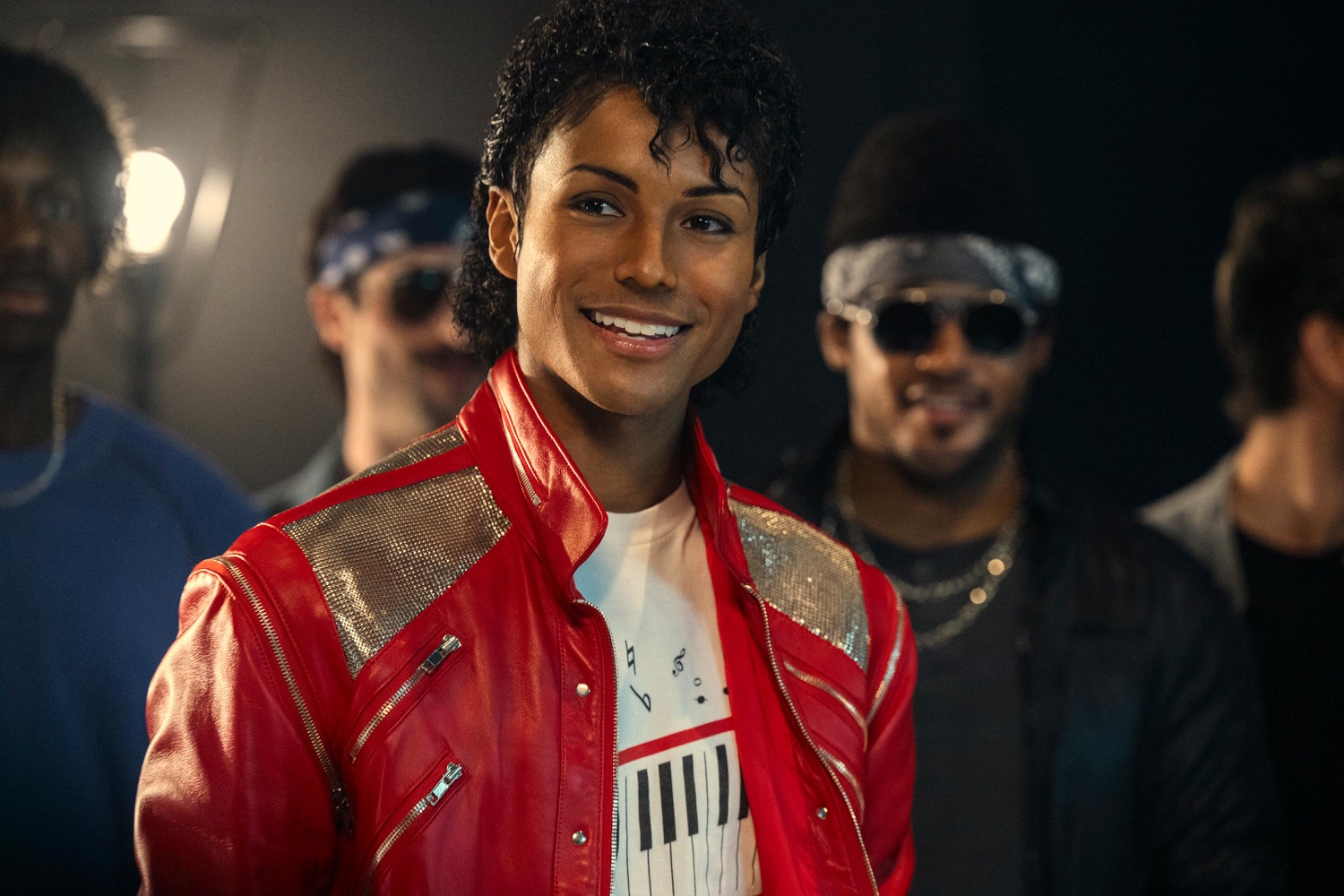
Most folks of a certain age who grew up with Jackson and his music have the benefit of knowing and directly experiencing the full trajectory of Michael Jackson’s career. They know all about the kid from Gary, Indiana and his five brothers; and how they formed a group that was a worldwide phenomenon. They know all about Michael Jackson the solo artist; whose “Off The Wall” and “Thriller” albums rocked the music world making him a superstar so popular, he even ( briefly ) dated the supermodel of the day back then, Brooke Shields.
… and they know about his slow spiral downward as well; the Pepsi commercial burns, the numerous plastic surgeries, the ever changing physical appearance and skin color… and of course, the allegations.
That generation has had time to process all that glory and insanity; and hopefully the ability to fondly remember Michael Jackson the exceptional music artist and performing genius; as well as to compartmentalize a critical eye to the later weirdness of “Wacko Jacko” too.
But, for the Gen-Z generation, Jackson is predominantly the guy with the odd, pale face who was, at minimum, very creepy around some kids and sang a few hits back in the day. This film presents them, and others, with a different and important facet to ponder and consider regarding this very complicated entertainer.
“Michael” is an entertaining and nostalgic look at the “other Michael” largely before all the weirdness and the controversy kicked in. It’s a look back at the genesis of an undeniably singular and arguably historic music talent, that despite the controversy that surrounds him today – still spawns thousands of avid imitators and inspires many more via his music and dance.
There no doubt will be a sequel to this film, possibly by Antoine Fuqua himself, to more effectively continue and comprehensively chronicle the tragic downward spiral and the unfortunate and untimely death of Michael Jackson. The final credits of this film strongly suggest that future possibility.
However, for now, “Michael” joyously celebrates the magnificent ascension of a global superstar that provided an incredibly fun, historic and memorable soundtrack to the lives of millions around the world.
… Cynics and “Rotten Tomatoes” critics be damned.